Commercial Kitchen Cleaning: The Complete Guide for Restaurant Owners
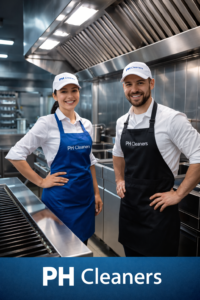
Proper commercial kitchen cleaning standards are critical for restaurant success, yet the task can feel overwhelming. Health inspections and daily operations demand spotless conditions while you run a profitable business. This requires strategic planning and expert support.
We understand the stress that comes with managing commercial kitchen hygiene. That’s why we’ve created this guide to help you with everything from establishing a commercial kitchen cleaning schedule to selecting professional commercial kitchen cleaning services. We’ll walk you through key areas like commercial kitchen hood cleaning and commercial kitchen exhaust cleaning, daily responsibilities, and how to find reliable commercial kitchen cleaning services near me. You’ll learn how to maintain exceptional standards that protect your customers and your reputation above all.
Why Commercial Kitchen Cleaning Matters for Restaurant Owners
Health and safety compliance requirements
Food businesses must comply with strict legal requirements governing commercial kitchen cleaning and hygiene. The Food Safety Act 1990 and Food Hygiene (England) Regulations 2013 establish your responsibilities for maintaining safe premises and hygienic practises. Regulation (EC) No 852/2004 requires you to implement procedures based on Hazard Analysis and Critical Control Points (HACCP). Meeting these standards is mandatory. Environmental health officers conduct risk-based inspections, assess compliance and take enforcement action when necessary.
Health inspections follow strict protocols. Inspectors review everything from food storage temperatures to cleaning routines, equipment maintenance and staff hygiene practises. Non-compliances result in graded outcomes, with major violations triggering written reports, improvement notices or closure orders. Professional commercial kitchen cleaning services help maintain inspection-ready premises at all times and prevent the buildup of grease and bacteria that attract regulatory attention.
Effect on food quality and customer safety
The statistics around foodborne illness are sobering. The United States alone sees 48 million people contract foodborne illnesses each year. This results in 128,000 hospitalisations and 3,000 deaths. The US FDA has identified five major risk factors that occur repeatedly: improper food-holding temperatures, inadequate cooking, contaminated equipment, food from unsafe sources and poor personal hygiene.
Research conducted with Indonesian catering services revealed that 75% of food handlers had limited knowledge of food safety. What’s worse, 95% had received no food safety training. Poor hygiene practises amongst food handlers increase contamination risks, as pathogens can transfer from handlers to consumers through improper handwashing, inadequate protective gear and unsanitary work habits.
Financial consequences of poor kitchen hygiene
A single foodborne outbreak can cost a restaurant between four thousand and 2.2 million dollars. This factors in lost revenue, legal fees and reputational damage. Failed health inspections lead to hefty fines, temporary closures and product recalls. Multiple failures without improvement result in more severe penalties, increased scrutiny and potentially permanent closure.
Reputation and customer trust
Trust collapses when hygiene doubts enter customers’ minds. Around 70% of diners refuse to visit restaurants that violate health codes. Cleanliness appears as one of the most mentioned topics in customer feedback. Hygiene ratings displayed on premises demonstrate transparency and build customer confidence. Poor ratings don’t just lose customers—they attract regulatory attention and damage long-term brand equity. Professional commercial kitchen cleaning ensures consistency and helps you maintain high standards even during busy periods.
Essential Areas Covered in Commercial Kitchen Cleaning Services
Professional commercial kitchen cleaning services address five critical zones that just need specialised attention and technical expertise.
Commercial kitchen hood cleaning systems
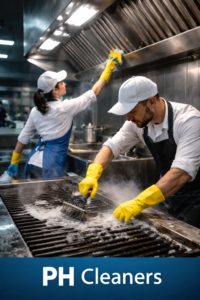
The hood canopy serves as your first defence against grease-laden vapours. Grease philtres just need cleaning at least weekly for light cooking operations and daily for high-volume establishments. These baffle philtres trap larger grease particles before they enter the ductwork. Cleaning must reach bare metal standards to prevent fire hazards and maintain proper function. Around 70% of commercial kitchen fires originate in extract ventilation systems due to grease buildup. Professional services remove all philtre components and soak them in degreasing solutions. They pressure wash until clean.
Commercial kitchen exhaust cleaning and ventilation
Ductwork cleaning follows TR19 industry standards, which specify grease levels must remain below 50 microns as an average throughout the system. Maximum permitted buildup reaches 200 microns before mandatory cleaning. Access panels must be installed about every 2 metres along ductwork to enable thorough inspection and cleaning. Technicians use Wet Film Thickness Tests (WFTT) to measure grease deposits in microns and determine required cleaning frequency. You receive a TR19 certificate of hygiene through the Ventilation Hygiene Register after completion. This serves as proof for insurance and legal compliance.
Kitchen equipment and appliances
Deep fryers just need monthly boil-out cleanings using water and commercial degreasing solutions. High-use fryers may need weekly boil-outs. Carbonization on fryer walls and coils forces machines to work harder for heating. This wastes energy and money. Ovens and grills accumulate baked-on grease that requires alkaline cleaning formulas designed for stainless steel surfaces.
Floors, walls, and drainage systems
Kitchen walls within 3-4 feet of cooking equipment need weekly cleaning with restaurant grease cleaners. All kitchen walls require monthly cleaning from floor to ceiling. Floor drains just need regular clearing of trapped food debris and grease, with periodic flushing using hot water and degreasers.
Food preparation surfaces and storage areas
Food contact surfaces require sanitizers that achieve a 5-log reduction and inactivate 99.999% of microbes. Surfaces must be cleaned between different tasks, especially after handling raw food. Work surfaces and chopping boards need both cleaning and disinfection using products that meet BS EN 1276 or BS EN 13697 standards.
Creating a Commercial Kitchen Cleaning Schedule That Works
A structured commercial kitchen cleaning schedule helps you avoid missing things and ensures consistency in all operations. The framework divides responsibilities into manageable intervals, from daily maintenance through quarterly professional services.
Daily cleaning tasks and responsibilities
Sanitise cutting boards and prep counters after each use. Employ colour-coded boards to reduce cross-contamination between raw proteins and produce. Wash knives and utensils in a three-compartment sink and dry them really well to prevent rust. Wipe down grills, flattops and stovetops at shift end. Clean drip trays and burner grates. Skim fryer oil throughout the day while wiping exterior surfaces. Sweep and mop floors with a degreaser after closing. Focus on corners where debris builds up. Empty bins before overflow and wipe containers with disinfectant.
Weekly deep cleaning requirements
Weekly routines target areas that accumulate grease over time. Remove oven racks and clean interiors with approved degreasers. Check gaskets and seals. Wipe refrigerator and freezer shelves. Check gaskets and discard expired items. Clean and inspect grease traps weekly to prevent odours and plumbing issues. Degrease walls and baseboards to remove splatter. Wash or replace ventilation philtres to maintain airflow and reduce fire hazards.
Monthly maintenance priorities
Monthly tasks require more planning but maintain compliance. Descale dishwashers to prevent mineral buildup. Check spray arms and drains. Schedule professional deep fryer cleaning and calibration. Clean ducts and exhaust systems to comply with fire codes. Sanitise storage shelving and inspect for pests.
Quarterly professional commercial kitchen cleaning services
Most establishments schedule deep cleans every three to six months depending on volume. Professional commercial kitchen cleaning services provide specialised equipment and expertise for commercial kitchen exhaust cleaning, ductwork maintenance and intensive degreasing that daily routines cannot achieve.
How to Choose Professional Commercial Kitchen Cleaning Services
Selecting the right provider requires careful evaluation beyond price comparisons. We’ve seen too many restaurant owners rush decisions and face compliance problems later.
Qualifications and certifications worth checking
Companies with ISO 22000 certification meet the global standard for Food Safety Management Systems that controls food safety hazards along the food chain. Staff should possess Safe Pass and Manual Handling certifications. The company must be insured with public liability coverage reaching up to 5 million. Trained and vetted employees demonstrate a steadfast dedication to professional standards. FSAI compliance will give your kitchen cleanliness that meets hygiene standards required by the Food Safety Authority of Ireland.
Questions worth asking before hiring
Request documentation that proves current certification status and ask how they maintain these credentials. Get the services you’ll receive in writing to avoid confusion. Ask if they provide post-service reports with before-and-after photos and ATP testing results. They should supply Safety Data Sheets for all chemicals used in your kitchen.
Comparing costs and service packages
Commercial kitchen cleaning costs between EUR 28.63 to EUR 95.42 per hour. Pricing varies based on kitchen size, current condition, frequency and location. Compare credentials with costs rather than selecting the cheapest option.
Working with commercial kitchen cleaning services near me
Request quotes from multiple local providers. Professional services offer flexible scheduling around your operations and create custom cleaning schedules using specialised software systems.
Conclusion
A spotless commercial kitchen might seem like a challenge at first glance, but the right schedule and professional support will protect both your customers and your business reputation. Start by implementing the daily and weekly tasks we’ve outlined, then partner with certified commercial kitchen cleaning services for deep cleaning requirements. Note that investing in good hygiene isn’t just about passing inspections—it’s about building customer trust and ensuring long-term success. Choose your cleaning partner with care, and you’ll notice the results.